
After 1,000+ Days Of Journaling: The 10 Prompts That Accelerated My Progress
And in this edition, you get a step-by-step guide to use them effectively
Greetings from the Dutch Countryside!
I’ve spent the last 3 days off the grid, reflecting on the last few months and setting my intentions for the months ahead. 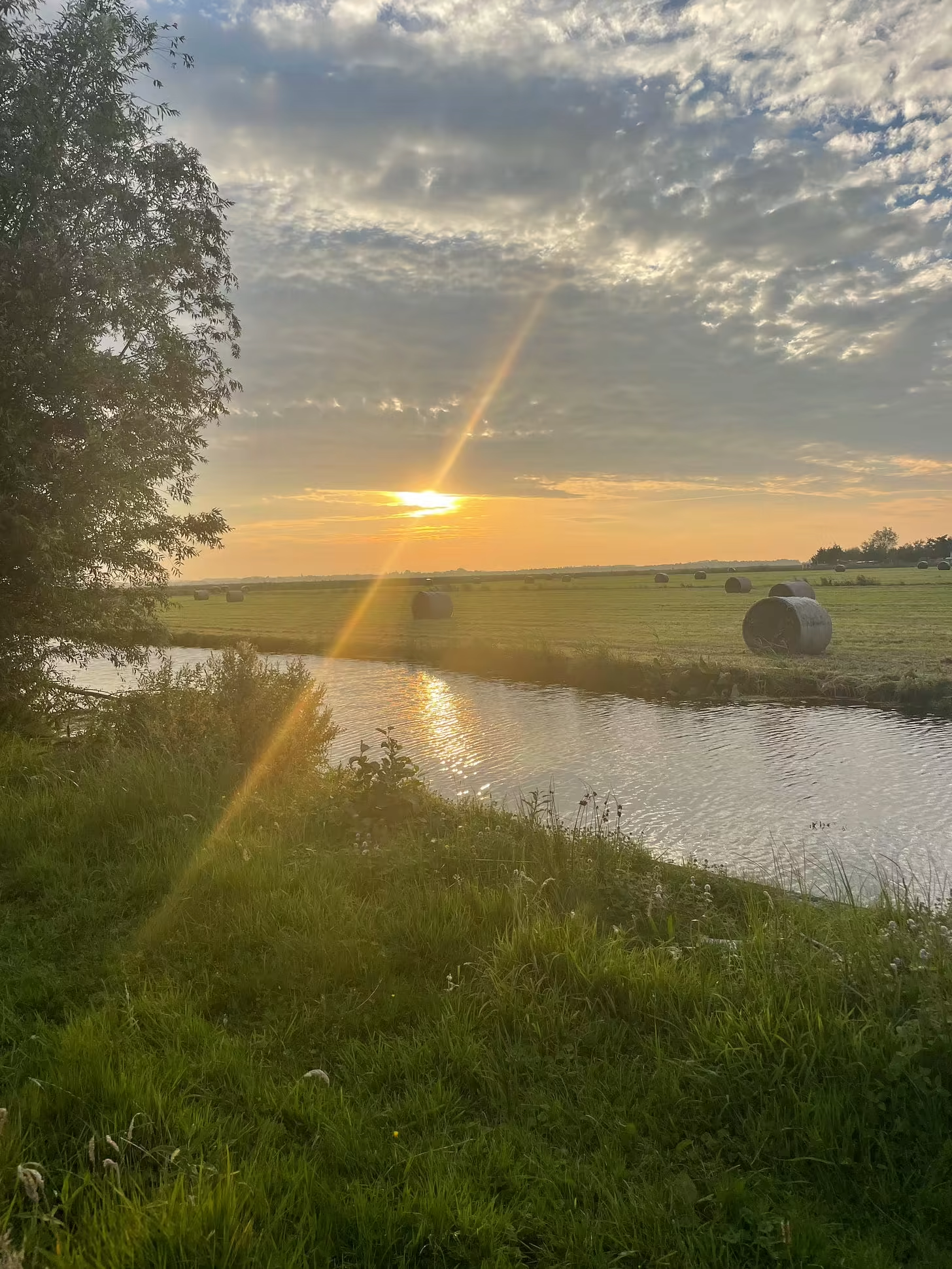 This time is on the calendar every quarter, tapping out from the day-to-day and zooming out to see things from a higher-level perspective.
Trip prep meant the normal routine: collecting questions to reflect on, books and podcasts to consume, and concepts to explore.
And today’s newsletter is part of that preparation process, gathering the most impactful journal prompts into a single note to work through with zero distraction from the outside world.
This edition explains each of them.
So today you get each prompt step by step: when to use it, what it helps with, and how to gain value from it.
This time is on the calendar every quarter, tapping out from the day-to-day and zooming out to see things from a higher-level perspective.
Trip prep meant the normal routine: collecting questions to reflect on, books and podcasts to consume, and concepts to explore.
And today’s newsletter is part of that preparation process, gathering the most impactful journal prompts into a single note to work through with zero distraction from the outside world.
This edition explains each of them.
So today you get each prompt step by step: when to use it, what it helps with, and how to gain value from it.
Quick heads up before we jump in: you can find a link to these prompts as a Google Doc and Notion Doc at the bottom of the newsletter. Over the last 5 years, I’ve journaled over 1,000 times. And during that time, I’ve:
- Answered question after question
- Tested app after app, notebook after notebook, pen after pen
- And learned more about myself than I ever thought possible All of that experimentation distilled into 10 simple prompts to rotate and revisit on a consistent basis.
- The 10-Bullet Brain Dump
- The Evening Shutdown
- The Bottleneck Analysis
- The 80/20 Life Audit
- The Gratitude Reframe
- The Billion-Dollar Reflection
- The Compounding Projection
- The Excitement Exploration
- The Future-Me Mentorship
- The Periodic Review And what follows covers each prompt step by step, when to use it, what it helps with, and how to gain value from it fast. Here they are:
Prompt 1: The 10-Bullet Brain Dump
My mornings start the same: the laptop cracks open and a blank note stares back. 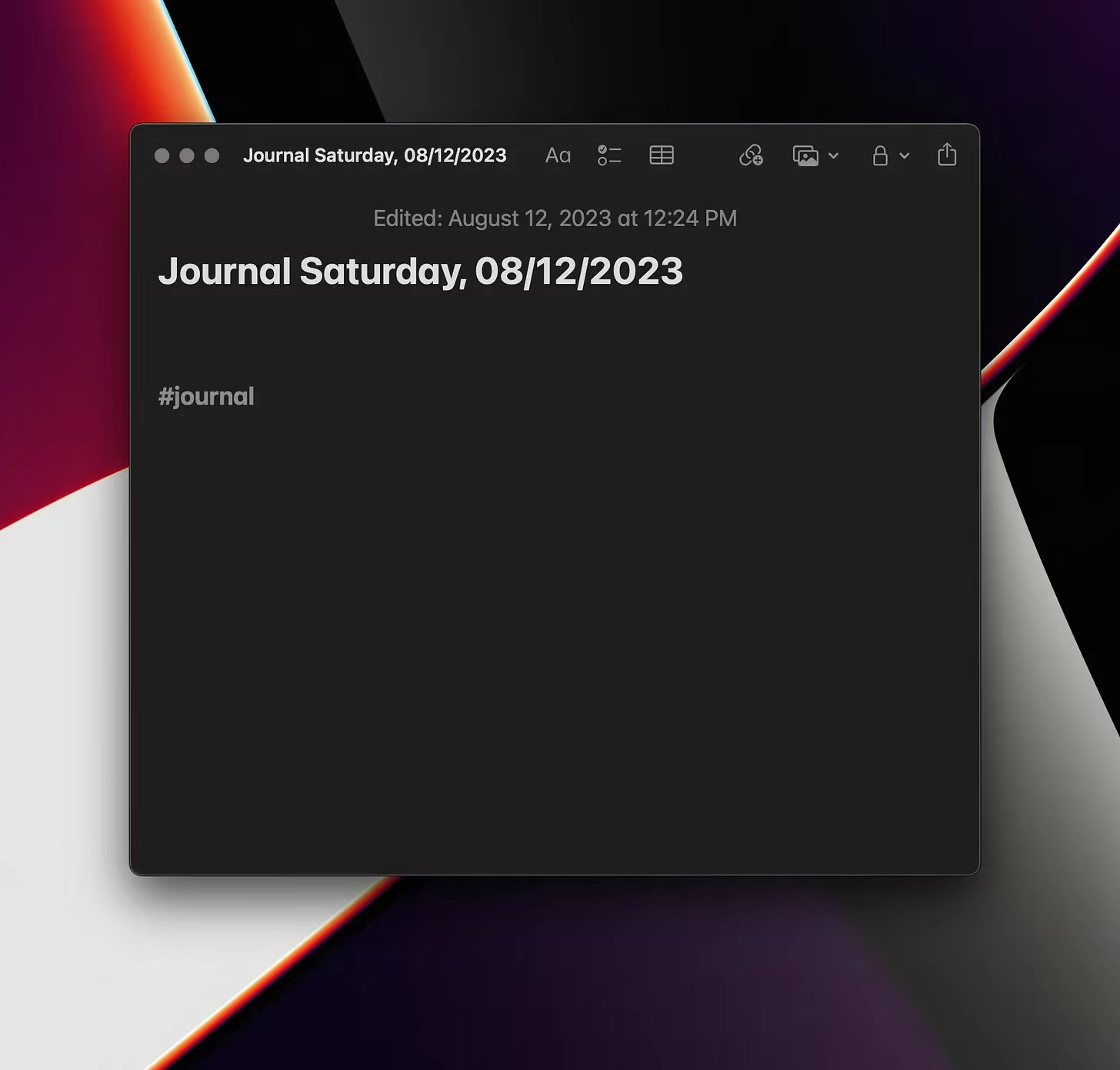 And I’ve been starting every day like this for the last 5 years.
Sometimes the bullets get a “theme”: startup ideas, concepts for future pieces, or people to catch up with. But most of the time, it’s just a list of 10 bullets that started swimming around the moment eyes popped open. So plan about 10 to 15 minutes to hash out these ideas as the double espresso works its magic through the veins.
Start your morning this way for 3 main reasons:
And I’ve been starting every day like this for the last 5 years.
Sometimes the bullets get a “theme”: startup ideas, concepts for future pieces, or people to catch up with. But most of the time, it’s just a list of 10 bullets that started swimming around the moment eyes popped open. So plan about 10 to 15 minutes to hash out these ideas as the double espresso works its magic through the veins.
Start your morning this way for 3 main reasons:
Start the morning with intention. If the first thing on screen in the morning is a browser with 100 tabs, the day is pretty much over. Open loops grab attention and immediately cloud the brain. But a blank note first means time spent processing whatever is top-of-mind, instead of reacting to things that feel urgent but aren’t important.
A practice for every day for the rest of your life. No matter where you are, who you’re with, how old you are, or what you’re working on, ideas to process show up at wake-up. So since this is an infinite game played for a long time, build the day around it as the foundation.
Better decisions, clearer thinking, and better habits. Use this writing time as a “coliseum for thought.” Work through decisions there, expand on ideas, or just close the loops eating up mental bandwidth. A few days without this time, and “sharp” fades along with control of actions and decisions. The last 5 years trace every good thing back to it. That’s why this is the easiest way to build both a journaling habit and a writing habit. And there’s no need to overcomplicate it either. Just follow these 2 steps:
- Before bed, leave your computer screen with all windows minimized except a blank note. (A physical journal works on weekends too.)
- In the morning, open your laptop, set a 20-minute timer, and brain-dump 10 bullets on whatever ideas come to mind Run this experiment every day for a month. The results will amaze you.
Prompt 2: The Evening Shutdown
Morning journaling is free-flow, unstructured, built to explore ideas. Evening journaling is quick, structured, built to consolidate them. At night, shut the phone down, pop open a Jotform survey and answer the following questions:
1. Rate the day on a scale of 1-10
2. What are 3 wins or moments of progression today?
3. What are 3 potential wins or moments of progression for tomorrow?
4. What is 1 lesson or realization you want to distill from today?
5. What is one area you could improve tomorrow?
6. Upload a photo of the dayThis takes 5 minutes at most, anywhere, in any city, at any time, with a phone in hand. The past held experiments with other end-of-day formats: handwritten, on computer, via voice note, etc. This format won for a few reasons:
- Low friction. Willpower dwindles throughout the day, so the evening routine needs the lowest-friction shape possible to stick.
- Ends the day focused on the positive. A moment reflecting on what went well that day and what can go well tomorrow constantly reinforces the actions that lead to progress.
- Creates a “ledger” to look back on over time. Answers pipe to a Google Sheet, each day its own row. Then, at the end of the week, month, quarter, or year, scan back through every single day to look for patterns.
- Forces more photos. With a photo of the day due, the lookout for highlights and moments to capture stays constant. For a closer look at this survey, its use, and its setup, hit reply or leave a comment. Just like the morning journal, there’s no need to overcomplicate it or try to figure out the perfect system from the beginning. This one has been worked and iterated on for a few years and still isn’t 100% right. To get started, just start a new note in your phone called “End of day survey” and start to jot down your answers to a few of the questions listed above (or whatever other questions you want).
Prompt 3: The Bottleneck Analysis
Mathematician Richard Hamming was known to sit down with experts from other fields, cut the small talk, and ask 2 questions:
- What’s the most important problem in your field?
- Why aren’t you working on them? This was off-putting to many colleagues, and it’s worth digging into why. Everyone has an answer to the first question. The biggest, most important problems are obvious to anyone working in that field. But the second question is a pain point. Why? Because it forces the person to confront the brutal facts of their situation. Answers to “Why aren’t you working on them?” will be some combination of denying, blaming, complaining, or defending. Which is exactly why Hamming asks them. The confrontation of the brutal facts comes only after all of these excuses are out of the way. That’s when the real work begins. This idea adapts far beyond career thinking. Whenever focus turns to improving an area, start with this “bottleneck analysis” question to identify the most important thing to work on. For example:
- What’s the biggest thing keeping you from improving your health? And why aren’t you working on it?
- What’s the number one thing preventing your business from growing? And why aren’t you fixing it?
- What’s the most important thing you could do to improve your relationship? And why aren’t you working on it?
- What’s the number one distraction keeping you from knocking out your focused work? And why aren’t you removing it?
- What’s the biggest limiting belief keeping you from starting that creative project? And why aren’t you breaking it down? This simple question pattern helps identify 1) the most important thing to work on and 2) the biggest thing preventing work on it. The more time, energy, and attention go to these “most important” bottlenecks, the faster the progress. This has been an important realization of the people I look up to who seem to move faster than everyone else. They don’t have more time, more energy, or more intelligence. Instead, their efforts always go to the highest-impact work. And it’s the relentless daily focus on that high-impact work, compounded every day for years, that leads to their outsized success. So to use this one, pick an area of your life you’re looking to improve. Set a timer for 30 minutes and ask the following 2 questions:
1. What’s the most important thing holding me back from achieving X?
2. Why aren’t I working on that?
Prompt 4: The 80/20 Life Audit
If you’re not familiar with the 80/20 rule (also known as the Pareto Principle), it goes as follows:
In any system, 80% of the outputs come from 20% of the inputs. The 80/20 rule starts showing up everywhere after you learn it.
- 80% of your profits come from 20% of your customers
- 80% of your bad moods come from 20% of your actions
- 80% of your work output comes from 20% of your time So this question takes this idea and applies it to your life, in 2 parts:
- The first 2 questions identify the areas of your life that you feel are going well and the areas of your life you feel could be improved
- The second 2 questions help you look closely to find the 20% of people, places, habits, and beliefs that are leading to 80% of your good results and 80% of your negative results From there, feed everything leading to good results and ruthlessly remove everything leading to negative ones. For example, here is what those answers surfaced:
- Go 500 days without alcohol to underwrite its role in daily life
- Realize the importance of writing every morning for 90 minutes
- Recognize the job I was in was not one I wanted to do forever
- Identify the relationships that were no longer serving me
- Change the weekly routine to better align daily activities This prompt kicks off a weekend reflection at an Airbnb in the Dutch countryside at year’s end. Reflecting on this one always leads to quite a few more questions afterward, which is why plenty of time and space help answer them. The next time you’re looking to do a full “audit” of the different areas of your life, block out some time (ideally 1-2 days if you can) and answer these questions:
1. What areas am I feeling satisfied with?
2. What areas am I feeling dissatisfied with?
3. What are the 20% of activities that are leading to the areas I’m dissatisfied - and how can I remove these?
4. What are the 20% of activities that are leading to the areas I’m satisfied with - and how can I feed those?
5. What steps am I going to take today based on this analysis? Chances are, you’ll easily find a pattern of people, places, habits, routines, and beliefs that seems to contribute to all of your positive and negative results. The hard part comes after, when you have to figure out what to do about it.
Prompt 5: The Gratitude Reframe
A gratitude practice took years to build. Answering the question “What am I grateful for?” never worked. Sitting there with journal and pen, the room got scanned for things in the immediate environment to list. Fresh coffee, the sunrise, a comfy work chair, it all just felt so surface-level. Until one morning last summer, I woke up with *debilitating* lower-back pain out of nowhere. For 24 hours, I couldn’t walk, bend, twist, lift, write, or take a deep breath without a surging pain radiating down my spine. But when I woke up the next morning after damn-near 12 hours of sleep, it was gone. Poof, like nothing happened. Completely back to normal, and it hasn’t returned since. That morning the gratitude prompt had a simple answer: a back feeling better. That’s when the pattern clicked: gratitude requires “relative” context. For the previous ~200 times that question got answered, healthy vertebrae never made the list. Years and years of taking them for granted. But the second they were taken away, a full page got written about having them back. So now the gratitude questions get a reframe. The new questions ask to think about what’s grateful-worthy relative to another time. Specifically, these 3 questions:
1. What do I have today that I would have begged to have had years ago?
2. What do I have today that my 85-year-old self would beg to have back?
3. What do I have today that my current self if he was sick or injured would beg to have had? When the questions get framed this way, answers pour out and gratitude runs deeper.
Prompt 6: The Billion-Dollar Reflection
There are 2 types of games in the world:
- Finite games. These are games with set rules and set players with a defined way to play. The objective of the game is to win. Baseball, chess, and elections for example.
- Infinite games. These are games without set rules or set players without a defined way to play. The objective of the game is to simply keep playing. Improving your health, writing poetry, or building a strong marriage for example. The key to a life of fulfillment is finding the infinite games you love to play and designing life around playing them forever. To find those games to play forever, use this simple question:
What could you not pay me 1 billion to stop doing forever? The activities worth turning down $1 billion to keep playing are the infinite game activities. For example, a handful of last month’s activities ran through this question. For these 5 questions, the answer was no:
- For $1 billion, would you never lift weights again? Absolutely not.
- For $1 billion, would you never write for 90 minutes in the morning again? Absolutely not.
- For $1 billion, would you never visit a new city again? Absolutely not.
- For $1 billion, would you never talk or think about business again? Absolutely not.
- For $1 billion dollars, would you never go to dinner with friends again? Absolutely not. Exercising, writing, traveling, reflecting, thinking about business, and spending time building relationships. These are the games to play forever.
This answer led to 3 core values: progression, connection, and reflection. A post covering these topics is in the works, so stay tuned for that one. These answers identified the activities to build life around forever. At the same time, it flagged the activities currently on the calendar that don’t deserve forever. So from here came a follow-up question: If no amount of money could stop these activities, how to shape life around doing them every day? And that left a rough “daily structure” to repeat while traveling:
- Morning writing & idea processing for at least 2 hours (done first thing over a crisp espresso)
- Spending a few hours in the middle of the day working on different businesses, collaborating with the team, and removing bottlenecks
- Lifting weights or exercising in some way during the afternoon, tapped out from the phone with full presence on whatever is happening
- Spending the evening with friends and loved ones, reflecting on the day, and exploring different ideas (to write about the following morning) The best part about this daily structure?
- It works basically anywhere in the world
- It works by myself, with friends, or with a future family
- An activity runs as a “container” for that type of work, which helps work less by minimizing context switching To find out what you enjoy doing (and what isn’t actually energizing you), give yourself an hour to reflect on this question.
Prompt 7: The Compounding Projection
Everything good in life comes from compounding. And compounding comes from doing:
- The absolute basics
- With monotonous consistency
- Daily, for a long period of time Said another way, it’s a combination of simplicity, consistency, and patience. But, human brains struggle to tap the power of compounding for a few reasons:
- Compounding is impossible to see in real-time
- It’s hard to connect the small actions to the big result
- Our society is built on instant gratification (which interrupts compounding) Luckily, here is a prompt that connects day-to-day activities with a long-term compounding result. After a particularly good or bad day, crack open a blank note and ask 2 questions:
1. If I repeated my actions from today/this week/this quarter for the next X period of time, where would I end up?
__
2. Is that where I want to be? Right away, these questions identify 2 things:
- If time works for you (and compounds to your benefit). For example, repeating the same healthy activities every day for 5 years ends in better shape. Spending 90 minutes every morning writing, every day for 5 years, ends in much better writing. That makes it much easier to connect a boring rep or a boring writing session to a long-term result.
- If time works against you (and compounds to your harm). For example, ending the night doomscrolling Instagram for 2 hours instead of foam rolling and reading brings no consequences tomorrow morning. But repeated every single night for 5 years, chances are, less happiness than otherwise possible. That makes it much easier to snap out of bad habits by connecting the seemingly harmless short-term action with the long-term negative result.
Prompt 8: The Excitement Brainstorm
This prompt is the world’s simplest dopamine hack.
- Title a blank note “Excitement Brainstorm”
- Brain dump 10 things coming up you’re excited about
- Relish in the number of things you have to look forward to Dopamine research shows brains derive more pleasure from the anticipation of an event than from the event itself.
- Most of the fun of Christmas comes during the lead-up to Christmas morning
- Most of the happiness from dessert comes from thinking about where you’ll go, what you’ll have, and who you’ll be with That realization, plus the power of the dopamine system, turns into a habit: constantly reflect on what’s ahead.
- Before bed, brainstorm what you’re excited about the next day
- Before a trip, brainstorm all of the places you’re excited to see
- Before a wedding, brainstorm all of the people you’re excited to catch up with This immediately elevates my state and keeps me motivated to find more exciting things to look forward to. And there’s an added bonus of looking back at prior entries to see the things that excited me at a certain moment in time. So give this one a try when you want a little boost.
Prompt 9: The Future-Me Mentorship
This prompt came from hearing Alex Hormozi explain it in this video. In the video, he breaks down the idea of the Solomon Paradox which says we give significantly better advice about personal scenarios to friends than we do to ourselves. This reflection takes that paradox and turns it into something you can use to make better decisions. The process starts with having a 30-minute “mentorship” conversation with your 85-year-old self. Basically, you crack open a fresh note and simulate a conversation about whatever decisions you are working through, This “future-me mentorship” back & forth works for a few reasons:
- It helps you remember the things you know you should be doing. Future you is there to remind you of things you already know.
- It works with someone with aligned incentives. Future you clearly wants what is best for current you.
- Separates your rational self from your emotional self. Future you isn’t clouded by all of the emotions responsible for the poor decisions of current you. This one serves best for big decisions or topics getting more mental bandwidth than they should.
- When deciding, take the option “Future me” would regret not taking
- When a topic gets too much mental bandwidth, a visit from “Future me” looks back and laughs at how trivial that event turned out to be This is the newest prompt on this list, and experiments with it continue.
Prompt 10: The Periodic Review
Last but not least: the foundation of the reflection routine, the Periodic Review. Spending time answering these questions documents and cherishes every moment of the journey. Over the next 5, 10, 20, and 50 years, that “ledger” will be there when reminiscing about a certain time period. At the end of every week, month, quarter, and year, crack open a fresh note and answer these questions:
1. What were the biggest highlights?
2. What were the biggest lowlights?
3. What areas moved forward the most?
4. What areas could have gone better?
5. What are the biggest lessons and realizations?
6. What excites most about the period ahead? And each of these periodic reviews builds on one another:
- At the end of the week, the daily survey answers that week’s questions.
- At the end of the month, the weekly reviews answer the month’s.
- At the end of the quarter, the monthly reviews answer the quarter’s.
- And at the end of the year, the quarterly reviews answer the year’s. And 10 years from now, the yearly reviews combine into a decade review. That will certainly be fun to write. Boom, that’s it, thanks for reading. Hopefully these help whether you’re completely new to journaling or a seasoned vet. Each of these plays a different role and purpose in the reflection process. Think of them as a “toolkit”: start with the outcome you’re looking to achieve, then work backward from there to find the right question. Also, these prompts live in a list below if you want to start answering them