
What the F**k is Agile? Let's Cut the BS
What the F**k is Agile? Let’s cut the BS
So you’ve heard of Agile, especially if you’re in tech or project management. What the hell is it? Agile got its fame through software development, pushed hard by the Scrum framework.
Been working with Agile teams for a decade. And let me tell you, it’s overhyped.
Skip the Agile bullshit
You can skip the rituals and keep the parts that help your team ship.
The essence of Agile: timeboxing
What should stick from Agile? Timeboxing tasks.
That’s it.
Say for the next 2 weeks, we’ll do just this, because we think that’s all we can handle.
After those 2 weeks, evaluate. Did you do more or less than you thought? Adjust accordingly.
What does not matter: the fluff
People obsess over the wrong things: t-shirt sizings, sprint rituals, poker planning, reviews, dailies. None of that matters.
Think a daily meeting is mandatory? Or that a sprint planning must last exactly 90 minutes? Forget it. These are distractions.
What works: simplicity
Create a timeboxed system with your team.
Decide what you’ll do in the next 2 weeks and put it on your task board, whatever tool you use.
I’ve seen better results with a skilled, cohesive tech team that didn’t bother estimating user stories than with teams acting like robots.
Fine-tuning your approach
When your team expands, it’s sensible to have some structure like demo, review, and planning sessions.
However, resist the urge to schedule excessive rituals. Shorten meetings. Prioritize async work. Lean on your project software’s comment section, use screenshots, and share videos to communicate. (I use tools like Loom, ClickUp, Birds eat Bug)
As for rules, it’s all about balance. If things are chaotic, introduce more structure. If your process is running smoothly, consider scaling back on the rules.
Adjust your approach based on the team’s performance and needs. It’s that straightforward.
Adapt and improve
That’s the most important part. The one you should focus on.
Did your team improve? Is your vision clearer? Are people more acquainted with the project? Is the vision sharper?
Maybe you’ll do more this sprint than the last. That’s the goal. But don’t get lost in frameworks and rules. Use what you need and ditch the rest.
So, if you’re drowning in Agile jargon and frameworks, remember: Timeboxing and reviewing team cohesion is the heart of it. Everything else is noise.
TL;DR
Here’s a 4-step system that’s a lightweight version of what SCRUM calls Agile.
Keep in mind, this method requires from everyone:
- Communication
- Transparency
- Patience
- Honesty
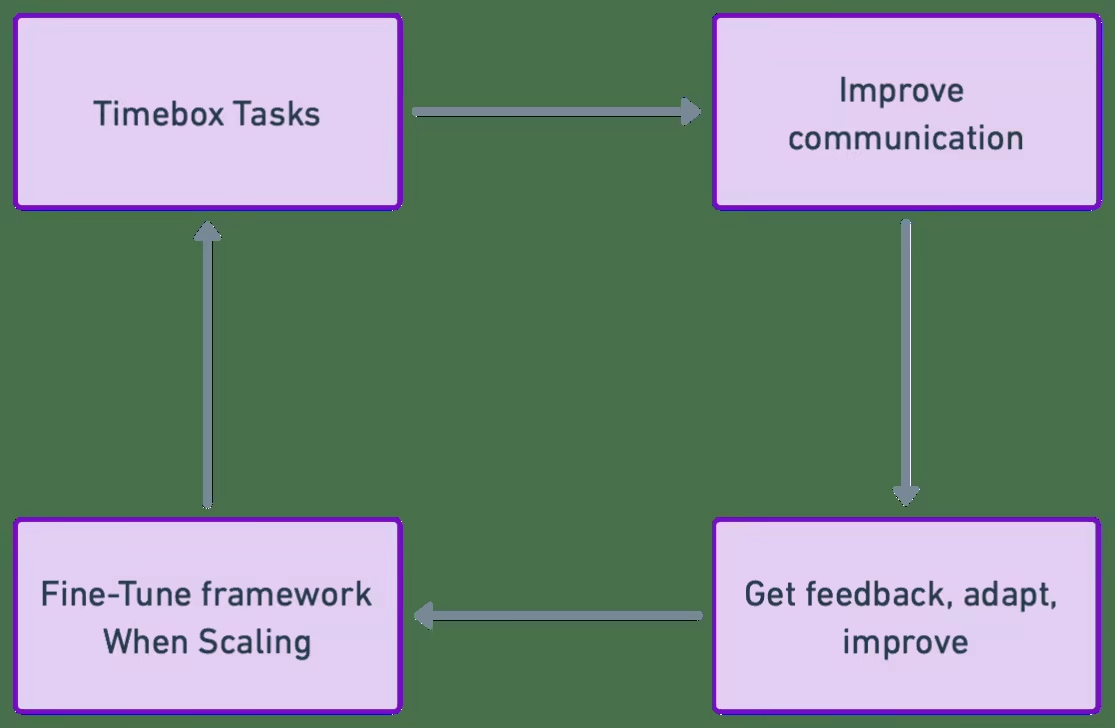
Step 1: Timebox Tasks
- Identify priority tasks for the next 2 weeks.
- Assign tasks to team members.
- Place tasks on your digital task board. Step 2: Simplify Communication
- Ignore unnecessary rituals like t-shirt sizings, poker planning, and excessive meetings.
- Keep meetings brief and necessary.
- Use project management software to keep track (e.g., Notion). Step 3: Get feedback, adapt, improve
- After 2 weeks, review completed tasks.
- Compare initial expectations with actual outcomes.
- Assess the level of chaos or smoothness in the workflow. Step 4: Fine-Tune When Scaling
- If your team grows, consider adding structure.
- Introduce demo, review, and planning sessions as needed.
- Add/remove rules based on the team output.